2016 Wrap Up

Week 5/Year 1 End NLV (AH): $2402.96 (-97.04/-3.88%)

The obligatory year end postmortem is upon us! Though our net liq (value above) shows us down 3.9 or so percent, it’s nice to see our overall YTD P/L +$43.00. I’m very proud of what we put together so far and excited to see what 2017 will hold. The positive P/L on the year is a nice icing on the cake for us moving forward. As the year is coming to end and our book is fairly well fleshed out at this point, I thought this would be a perfect time to reflect on what we’ve learned so far and map out our plan and goals for the coming year.

Lessons Learned

Two trading months aren’t much to start gleaning deep insight, but I believe we have learned a few things already. First off, and most obviously, was the catastrophic failure of the AAPL double calendar. In retrospect, I have no idea why I put on a calendar so far OTM. It was way too directional to be a straight vega play, and suffered even though IV shot from the 2nd to the 20th percentile in around a week. Had I placed it ATM we probably would have been at max profit today. Lesson learned.

The second lesson is that when placing defined risk trades, if we can’t afford to make the wings sufficiently wide, it might be best not to place the trade at all. On the BAC and PG spreads in particular, the tight wings give us a relatively narrow profit corridor. Apart from simple price dynamics, by buying tight wings we minimize the differential between the vega we’re buying (long strikes) and the vega we’re selling (short strikes). We should strive to come as close as we can to synthesizing strangles and straddles if that’s the type of volatility play we want to make.

The third lesson isn’t really a lesson, but more something I didn’t realize before. If we put on a defined risk trade such as an iron fly or condor, we enter the trade with very specific volatility assumption and risk tolerance. If we roll one side or the other, or adjust the legs, we change the risk profile of the trade. Should we treat this as a completely new trade? Should we take the old trade off and put an entirely new spread on instead? At what point (volatility or price move) should we start making these decisions? I honestly don’t know yet, but I’m going to get in the books soon and try and figure it out. If you have an idea, please leave a comment or drop me a line.

Looking Forward

In the year ahead, I have a single goal: to reach a net liquidating value of $5,000, which is double our starting capital. This milestone isn’t entirely arbitrary; it will open up futures options, the ability to trade naked options on cheaper instruments, and give us some opportunity to buy stock here and there. In addition, I want to stay focused on volatility plays and not stray away from our original rules. We simply don’t have enough capital to try and play big macro trends or stock direction and volatility at the same time in my opinion. For the time being, I’d also like to focus more on ETFs and indices than individual stocks to avoid earnings gap risks. In the upcoming earnings cycle I’m sure we’ll make an earnings play here and there but I forsee it difficult to apply our volatility trading techniques when gap risk is so significant as with earnings. Particularly with defined risk trades, you’re making a bet with unknown odds on either the stock staying within the implied move or blowing it out of the water one way or the other depending on how you play it. I’d rather sell iron condors on a bond ETF with high IV, but we’ll see. Money’s money.

Happy New Year, and Go Blue.
Flying off the Handle

Week 5 NLV (AH): $2308.98 (-$191.02/-7.64%)

Today was the first trading session since the Christmas break and marks the start of the weird period between Christmas and New Year’s where trading gets very thin and big houses start to tidy up their books via position rebalancing, tax selling, etc. Since volumes will start to pick up again in early January leading into the next earnings season starting shortly thereafter, I decided to make some more adjustments today and deploy some dry powder on strategies with nearer than usual expirations. All in all five trades were made today: one roll, one to open, and three adjustments.

Two of those three adjustments were on the SPY and QQQ put debit spreads we opened last week. Price isn’t going where we need it to (down) and IV is ticking up a bit, leading to the spreads showing paper losses of around 10% each as of this morning and needing pretty significant down moves in the coming weeks, which is looking less likely than I originally thought. To take advantage of the recent creep upwards in IV and reduce the capital risk of the spreads, I sold the mirror image of the put spreads originally purchased — turning it into a butterfly, or “flying off” the spread. For the original SPY 223/228 put debit spread, this meant selling the 218/223 put spread for a credit of $0.78 to create a 218/223/228 put fly for a net debit of $1.27. For the QQQ 118/122 put debit spread, it meant selling the 114/118 put spread for a credit of $0.51, creating a 114/118/122 put fly for a net $1.08 debit.

Both of these trades, while not really my favorite way to adjust, raised our upside breakeven points, introduced a bit more short vega/long theta, and reduced our directional exposure (trading it for exposure to large downside moves).

Our other trades today were opening a short iron condor in PG (80/82.5/85/87.5) in the Jan’17 monthlies for $1.07 to offset some upside risk in our current iron fly, rolling down the BABA call half of our IC (again) to the 90/94 for $0.53 to flatten deltas, and selling the 111/114 call spread in GLD Jan monthlies for $0.49.

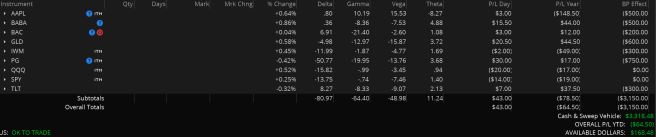
In the interest of brevity, here’s a snapshot of our current portfolio:

screen-shot-2016-12-27-at-7-27-35-pm

That dumb AAPL double calendar is still killing me and will likely be closed for near even (max loss) tomorrow unless I can pull off a fancy roll that moves it closer to the money without incurring any more margin or cost.

Sleeper Session

Week 4 NLV (Weds close): $2332.88 (-167.12/-6.7%)

More Delta Adjustments

Today’s U.S. session was extremely boring, which was a bummer since I didn’t have anything keeping me away from trading. Slow sessions can be nice since there’s no rush to get things done, but a three point range on the S&P until 3:30PM is like watching paint dry. Volatility across the board is still extremely depressed; in fact, the VIX hit the 10 handle this morning. Regardless, I made a few adjustments I thought I’d share.

If you’ll recall, a few weeks back we sold a GLD iron condor in the January ’17 monthlies for $0.70, with the short strikes near 20 delta. GLD IV — call IV in particular — has gotten smashed since we put the trade on, and the call half of the spread was trading for around a nickel. Being that cheap (and OTM), combined with the low IV, the call legs were contributing almost nothing to our position greeks.  With only a few pennies left to make, all that was left was downside (i.e. capping profits to the upside). I also looked at rolling the spread down but unless I wanted to widen the strikes out and take on more risk, the credit was abysmal. I ended up getting the call spread off for $0.04 + commissions at around 10:00AM, leaving us with a 20 delta, $3 wide put credit spread for a net $0.64 less commissions (so probably $0.50 or so all said and done). Combined with our other GLD spread, our current position greeks are as follows:

GLD Position Greeks: 18.14Δ, -8.39, -11.96ν, 2.00θ

A bit later I took a look at our TLT iron condor to make a delta adjustment, as it was getting a little heavy for my comfort. This spread was initially put on for a credit of $1.27, also with $3 wide wings. Unlike GLD, the TLT IC still had a little juice left in the call spread, so I decided to roll down as a straight delta adjustment, and was able to roll down to the 120/123 for a credit of $0.42, bringing our total credit for the position to $1.69 less commissions. I picked those strikes to bring the spread back close to 0 delta. At the time of the trade, the put legs of the IC had deltas of around 16 and 38, and the call legs we rolled into had deltas of 34 and 14.

TLT Position Greeks: 1.03Δ, -6.43γ, -9.15ν, 1.77θ

Dividend Risk

Overall though, today was pretty good P/L-wise, ending up about $52 on the day thanks to the Russell taking a dive in the last hour of trading. Speaking of which, tomorrow IWM goes ex-dividend, which is important for options traders. Any time you find yourself short calls on a stock or ETF that’s about to go ex-div, you’ve got exercise risk — that is, risk that the buyer of the call you sold will exercise in order to receive shares and therefore the dividend that comes with them. It’s crucial to determine how much risk your short calls have of being exercised — nothing’s worse than waking up and finding yourself short $80,000 worth of SPY on a $2,000 account. I know first hand, and it doesn’t end pretty…I was able to cover the position on open and only ended up eating $800, which sucks but is a lot less than $80,000!

Anyway, the main idea with dividend risk is that if the extrinsic value (time value premium) left in your calls is greater than the value of the dividend, you’re more than likely good to go. This makes sense intuitively if we use an example. Let’s say IWM is trading for $100 and you’re short a $99 call, which is currently trading for $3. Tomorrow’s dividend is $1. The person that bought that call has two options going into ex-div day: sell the call for $3 or exercise to buy 100 shares for $99 (netting $1/share if sold for $100 tomorrow) and receive a $1 dividend. Which would you pick, $3 or $2? The extrinsic value of the call here is $2, since it’s trading for $3 and $1 ITM.

screen-shot-2016-12-21-at-8-10-25-pm

In ToS, you can see how much extrinsic value an option has by adding it in your option chain settings, or simply taking the market value of the option and subtracting the amount by which it is in the money. In the case of our IWM IC, we’re short the $136 call, which closed around $2.71. Since IWM closed at $137, that means the call has (had) $1.69 of extrinsic value. The IWM dividend, from what I can find, will probably be no more than $0.70. Is the call an exercise risk?

Portfolio Greeks (AH, unweighted): -79.12Δ, -38.67γ, -27.62ν, 7.52θ

More Delta Adjustments

After opening the two put spreads and adjusting the AAPL double calendar, I had two more delta adjustments to do. Our short IC’s in IWM and BABA (remember we adjusted one of the wings here to limit downside exposure) were coming in decently from a vol perspective but position deltas in both were beginning to get out of control. Early in the afternoon the delta on the BABA IC was more than triple the vega, and 10x for IWM, indicating we had much more directional exposure as volatility exposure. Since both spreads were put on as volatility plays, I want to minimize directional exposure before it begins to completely engulf the position.

For BABA, I rolled the short call leg of the IC from the 97.5 strike to the 94.5 strike for a $0.36 credit, cutting down our position delta from around 12 to closer to 3 and getting us short some more IV (recall that the closer to ATM you get, the higher the volatility exposure). This leaves us with 13Jan16 80/85/94.5/99.5 IC for a total credit of $1.36 less commissions.

BABA Position Greeks: 3.37Δ, -5.88γ, -7.83ν, 3.49θ

IWM was a little more tricky because the underlying has had such a rally — and accompanying IV depression — since we put the spread on initially. I waited perhaps a bit longer to adjust than I should have because of how much time remained on the spread, but with the position delta nearly 30 with vega closer to 3, I felt the need to pull the trigger today. I ended up rolling the put half of the IC up to the 129/132 for $0.45 credit, cutting the position delta by around 66% and adding some more short vega in the process. Remembering that the IC was put on initially for $1.02, our new cost basis is $1.47 less commissions.

IWM Position Greeks: -11.68Δ, -1.51γ, -4.37ν, 1.05θ

Finally, the index ETF put spreads (SPY/QQQ). I don’t normally like to make directional bets, but with the VIX tapping the mid-11’s today and both near all time highs, I wanted to put on trades that would benefit from a move down or an increase in IV. The calendars were trading a little more rich than I cared for and any backspread for a credit would have been way too wide for me to be comfortable with, so I settled on put debit spreads. With debit spreads I like to buy a strike or two in the money so I’m buying more intrinsic than extrinsic (volatility/time premium), and sell at least $2-3 dollars OTM. For a put spread, this gives us the opportunity to not only sell some skew but also be able to adjust the short strike up should price run away from us. Again, not a pure vol play, but definitely gets some help.

  • BTO 1 SPY 27Jan17 223/228 put spread @ $2.00
  • BTO 1 QQQ 27Jan17 118/122 put spread @ $1.59

Porfolio Greeks (AH, unweighted): -78.66Δ, -32.54γ, -24.00ν, 6.28θ

Almost all of the spike in portfolio delta comes from the SPY and QQQ debit spreads, which contribute -30 and -31 delta, respectively.

AAPL Adjustment

Week 4 NLV (Monday close): $2331.52 (-168.48/-6.7%)

One of our busiest days so far with six trades, so let’s jump right in! Two of the six trades were to open — long put spreads in SPY and QQQ to take advantage of extremely low volatility and take a small directional gamble — while the remaining four were mostly delta adjustments of existing positions. Keeping in mind that when we put on volatility trades, we want to try and keep our exposure mainly to volatility instead of direction or other factors. As positions evolve, we want to keep an eye on our greeks and take action when those “other factors” (typically delta) begin to overshadow the one we intended to trade in the first place (vega).

The easiest decisions to make when adjusting greeks is the closing of “units,” which are options we have sold and are now worth close to zero. For example, in the AAPL double calendar we bought, the short leg of the put half of the spread was trading at open for 0.01 x 0.02. Is a short option trading for almost zero helping us take advantage of volatility? I’d argue no, in that the price of that option can go down only one penny to no bid x 0.01 and up as far as volatility allows. I closed that leg near the open for $0.02, leaving us long two legs and short one more 23Dec leg (109 call), which was deep ITM and an exercise risk. That leg was rolled one week out to the 30Dec 109 for a credit of $0.05. Including commissions, the entire adjustment was flat within a dollar, leaving us the following adjusted position:

  • (-1 AAPL 30Dec16 109 call, +1 AAPL 06Jan17 109 straddle) @ 1.05

AAPL IV remains in its 2nd percentile, and I’ll be looking to manage this trade as soon as possible. Best case at this point would be a quick move down towards the short 109 call and/or an increase in IV. With 11 days to go on the short call and 18 on the long legs, time is running out.

AAPL Position Greeks (dbl cal + backspread) : -9.79Δ, 10.39γ, 20.62ν, -5.58θ 

Slow and Steady

EOW 3 NLV (AH): $2293.89 (-206.11/-8.2%)

In a previous post I talked about buying more vol in AAPL and bought a put backratio spread in the hopes that IV would start to tick up. Since then, the stock has gone up almost 5% and IV is only a point or two higher. The vega of the long legs dropped as they moved farther OTM and as a result our position vega got cut nearly in half. I’m still of the opinion that IV in AAPL is significantly underpriced, and decided to roll the spread up and out to the 109/113 13Jan put backratio (+2/-1) to the 115/120 20Jan for $0.69 credit. This had the dual benefit of moving our breakeven prices up several dollars and get long more vega (~18 vs 9 before adjustment). I don’t normally like to take on more risk with a roll ($3 wide rolled to $4 wide) but I felt the credit taken in combined with extra duration and more favorable vega exposure made it worth it.

Later in the day I finally put a position on in BAC, selling 2 of the 20/21/25/26 27Jan17 iron condors for $0.25 a piece. For such a low credit — even less after commissions — it was a tough trade to construct, but the risk:reward of 3:1 is in line with what I shoot for and BAC IV has been floating just above its 50th percentile for a few weeks now.

Finally, I sold another IC in GLD to take advantage of the still-inflated IV, picking the 102/105/111.5/114.5 27Jan17 for $1.11. On entry the spread was almost delta neutral, short ~3.75 gamma and ~7.3 vega, and long 1.2 theta.

In other news, I’ve become very comfortable with our top 10 underlyings and decided to add two more to give us more opportunities. I stayed within CBOE’s top 20 stocks by option volume for November and settled on XOM (Exxon Mobil) and GILD (Gilead Sciences). These two stocks have very liquid option markets and give us exposure to two new sectors. Both are also decently priced stocks which is helpful.

  1. Roll 1 AAPL 109/113 13Jan17 –> 115/120 13Jan17 +2/-1 put backspread @ $0.69
  2. STO 2 BAC 20/21/25/26 IC @ $0.25 per
  3. STO 1 GLD 102/105/111.5/114.5 IC @ $1.11

Portfolio Greeks: -16.34Δ, -26.24γ, -10.87ν, 5.79θ

First Closed Trade

Week 3 NLV (AH): $2376.23 (-$123.77/-4.95%)

I apologize for the big gaps in updates…apart from a slow market, I’ve been pretty busy with real life the last couple weeks and trading has taken the back seat.

On the brighter side, I closed our first trade this week, the FB 125 put calendar. The strike selection on the calendar was very poor in that while it was cheap, there was too much dependency on a directional move for a volatility play. A strict vega play should have been placed closer to the money. I was trying to play the skew and in doing so lost sight of the reality that the stock still needed to move $6 in a couple weeks w/ steady vol or stay flat-ish with a huge volatility move to make a decent dollar profit. I got lucky when yesterday FB shot up ~$3 and I was able to sell the calendar for $0.41. Since we bought the cal for $0.27, that’s a gross $0.14, or around 50%. If you factor in commissions, it was bought for $0.30 net and $0.38 net. Not great, not bad, not a loser. I’ll take it for now. Small steps.

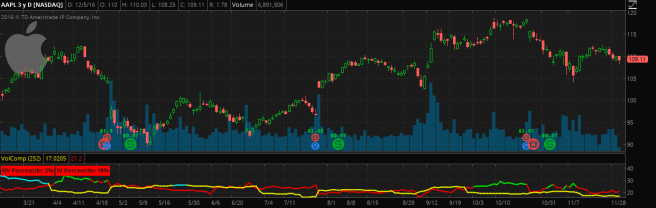
Despite the moves in gold and bonds after the fed meeting today, our short vega plays in BABA, GLD, IWM, PG, and TLT are slowly but surely starting to come in. PG and IWM are contributing a lot of short delta to the portfolio but with so much time still left I’m hesitant to make adjustments on those positions. The combined AAPL position is the big loser and I’ll be looking to make some adjustments to it early next week. AAPL is still sitting on the extreme low end of its IV range, and in order for this position to come in we need either a moderate move down in the stock or a tick up in IV towards the mean. In retrospect, I should have avoided trying to call the bottom in IV and waited for it to start riding back  up. Good lesson moving forward.

In other news, I’m considering replacing BAC in our top 10. It’s a cheap, relatively non-volatile stock that even with IV in the 73rd percentile presents very few attractive trades for us one-liners. I’m hard pressed to justify selling a 20 delta IC for $0.60 when the commissions are going to take $0.06 of that right off the bat.

BTC FB 23DEC16/06JAN17 125 put cal @ $0.41 (Open @ $0.27)

Russell Rally

Week 2 Net Liquidating Value (After Hours): $2376.32 (-$123.68/-4.95%)

It’s been a fairly slow trading week so far, which is both good and bad. Our short vol positions are starting to come in, but our long vol positions (FB and AAPL) haven’t seen IV creep up yet and are sitting flat or slightly negative. AAPL IV in particular got so low earlier this week (2nd percentile) that I decided to buy some more vol and put on a -1/+2 113/109 put backratio on the 13Jan17 weeklies for a credit of $0.16, adding around 15 vega to our position. On top of the double calendar we put on earlier, we’ve now got a strange looking position that is about -17 delta, long ~2 gamma, long ~19 vega, and roughly -2 theta. A nice side effect of the backspread was that it eliminated our downside risk below $110ish, but the main idea was taking advantage of the severely depressed IV in AAPL. Time will tell if we put this trade on too early, but as it stands we have 36 days for vol to come in.

The Russell 2000 (IWM) has had a monster rally this week, already exceeding the 1 s.d. implied move for the January 17 monthly expiry, and volatility has dropped accordingly. IV for IWM is now about 2-3 points lower than it was when we put our iron condor on last week. IWM’s rally poked above the short strike of the call half of our IC and I decided it was time to make an adjustment. Typically I would roll the put spread up to bring our position delta back in line, but the put vol dropped so much this week that rolling the puts up almost $10 was only showing a credit of around $0.30. With so much time left on the spread, the huge reduction in our downside cushion for that small of a credit didn’t seem to make sense. I also explored rolling the puts up to the 133/136 to make the position into an iron fly, but with IV so low, getting short that much vega didn’t make sense either.

So instead, I did something a little different that I’ve actually never done before. The put skew on IWM was so steep today that I was able to roll the long leg of the put spread from 120 to 122 for $0.12 debit including commissions, nearly eliminating our downside risk below $137.5 with very little change to our position greeks. Essentially, we paid $12 to take $200 of downside risk off the table. What we ended up with was a position similar to the BABA IC from last week. With so much time left on this spread (43 days), I’ll probably let it ride for a while and let the numbers play out. If the rally continues and IV continues to fade, we’ll take this one off for a loser. In any other price/vol combination, we might have some options.

As far as the rest of our portfolio goes, we’re pretty near flat. For losers we’ve got the IWM spread down 17% and the PG fly which has been up and down near 0 but is marked at -2% right now. For winners, the BABA and TLT IC’s are both up about 10% and the GLD IC is up almost 30% (IV got smacked). For I’m getting weird marks AH with the FB and AAPL positions but both were about flat at close today.

Portfolio Greeks

As we enter the second week of the project, it seems like a good time to take a look at our current portfolio greeks and make sure we have a plan moving forward. On an unweighted basis, we’re currently (as of Monday close) holding about -7 delta, -23 gamma, -29 vega, and +9 theta. I really don’t want to obsess over greeks since there’s not a whole lot we can do yet to fine tune them, but it’s important to keep in mind where our biggest risks are. We can see from the values about that ours are in convexity (gamma) and volatility (vega). What’s our worst case scenario? Overall, it looks like a large move coupled with a spike in volatility would blow us out. With equities volatility tends to move higher on down moves, so really we’re talking about a large down move resulting in higher volatility. This is the reason why we carry short delta when we’re short vega. Is -7 delta enough to balance -29 vega? To be honest, I’m not sure yet. We’ll find out together.

For the four trades we put on last week, from where I sit they seem to be coming in nicely. My aftermarket marks are a little goofy today but when the market was open PG IV was contracting, helping our short iron fly out, and TLT and GLD were both moving back towards the center of our short iron condors. IV for both is just starting to point down but is more or less where it was when we put those trades on, so for now we’re at the mercy of time and delta. IWM vol poked down a bit but the underyling moved against us a bit today so that position is down a few dollars so far. Those four still have 46 days until expiration and I won’t be touching them for a while.

We’ve still got around 30% of our buying power left, but I’d like to hold off on putting more positions on for a while. Going all in this early will put us in a corner if the market makes a large move one way or the other and will prevent us from taking advantage of big opportunities should they arise.

AAPL Double Calendar

Week 2 Start (Intraday): $2467 (-$33/1.32%)

Note: Will be using net liquidating value of account for P/L calculations moving forward. This should take into account commissions with the portfolio’s current mark-to-market. Was using the position total P/L value before which ignored commissions.

As part of a recent post I discussed the importance of diversification in strategy. The portfolio as of open this morning was all short vega trades: either short IC’s or iron flies. I figured today was as good a day as any to look into our top 10 and see if there were any opportunities to buy volatility. Buying vol can be tricky business; it can linger near or below its mean for longer than you might expect or want it to. When vol spikes it feels easier to time the sell since we know that, generally speaking, extremely high IV gets ironed out by the market pretty quickly. So I wanted to be careful and make sure not to buy vol just for the sake of buying it. Enter AAPL.

aapl

It might be hard to see in the screencap, but when this was taken AAPL’s 45 day realized volatility was sitting in the 2nd percentile and IV in the 13th percentile, with about a 4 point differential between the two. This seems like a good place to buy in some vol for two reasons, the first of which is that IV relative to itself is depressed. The second reason is that realized vol relative to itself is on the extreme low end, which implies we can expect to see a rebound at some point in the future, pushing IV with it.

So how do we go about buying vol? As with selling vol, we have a few ways of going about it. Debit spreads benefit from expanding vol (in that they widen), but come with more delta risk than I want right now. Backspreads have less delta risk but can be tricky to place when we need to keep strike width low. Buying strangles and straddles take on the most vol but are expensive, carry a lot of long gamma, and are short/negative theta. That leaves us with the calendar. Calendars are slow, weird animals that don’t pay much but offer a decent way for us to get long some vega without too much notional or directional risk.

With a calendar or diagonal we’re picking strikes across two different expiries, so it’s important to take a look at the term structure of the underlying before jumping into strike selection. To start, I tossed out the Jan’17 monthlies since I have enough exposure in that month. In keeping with the 30-60 day idea, I looked at the 6Jan17 and 13Jan17 weeklies (32 and 39 days respectively) for the long leg of the calendar. The 13Jan’s at 39 days actually had the lowest average IV of any expiration cycle available so that was a quick choice. For the short leg I went with the 23Dec16’s as the IV was about a full point higher and at 18 days gives us some time for the spread to work.

With a calendar the next step is strike selection. I wanted the most vega exposure I could get since this is a pure vol play so I looked for the best opportunity near the money. It happened to work out that IV in the Jan cycle happened to flatten out right near the ATM 109 strike on both the call and put side. I don’t want to buy already inflated IV in the hope it will inflate further, so I went with the ATM strike for the long leg. In the front week the IV curve is similar so I went with the ATM strike as well, trading the vega I lose from selling ATM with the directional risk I’d be taking on by selling OTM.

The final step is decided whether to sell a put or call calendar. Since ATM IV on both sides was just about the same (~15%) and the both spreads are fairly cheap, I went with both and put on a double calendar for a total debit of $1.05. The risk:reward ratio here is about 1.8:1, but I’ll be looking to take this off in the 25-50% profit range. If the stock moves quickly but IV inflates enough to roll the front week out for enough of a credit to justify the risk of holding the back month, I’ll explore that as well.

I know this was pretty long winded, but calendars are a lot more tricky to deal with than most people realize, including myself the first few times I traded them. They have very strange exposures and move very slowly sometimes. I’m hoping to manage this one in the next week or two.

Apart from that, I also put on an OTM call calendar in FB and sold an IC in BABA with uneven wing widths to sell some skew. Currently we’ve got 7 positions on in 7 of our 10 underlyings (all but BAC, SPY and QQQ).

Today’s Trades (greeks near open):

  1. BTO AAPL 23DEC16/06JAN17 109 dbl cal @ $1.05
    • D: ~0
    • G: -4.8
    • V: 6.3
    • T: 1.9 (note: long vega and theta)
  2. BTO FB 23DEC16/06JAN17 125 put cal @ $0.27
    • D: 4
    • G: 0.37
    • V: 3.19
    • T: 0.42
  3. STO BABA 13JAN17 80/85/97.5/99.5 IC @ $1.00
    • D: 5.8
    • G: -2.5
    • V: -5.6
    • T: 1.7