Week 2 Start (Intraday): $2467 (-$33/1.32%)
Note: Will be using net liquidating value of account for P/L calculations moving forward. This should take into account commissions with the portfolio’s current mark-to-market. Was using the position total P/L value before which ignored commissions.
As part of a recent post I discussed the importance of diversification in strategy. The portfolio as of open this morning was all short vega trades: either short IC’s or iron flies. I figured today was as good a day as any to look into our top 10 and see if there were any opportunities to buy volatility. Buying vol can be tricky business; it can linger near or below its mean for longer than you might expect or want it to. When vol spikes it feels easier to time the sell since we know that, generally speaking, extremely high IV gets ironed out by the market pretty quickly. So I wanted to be careful and make sure not to buy vol just for the sake of buying it. Enter AAPL.
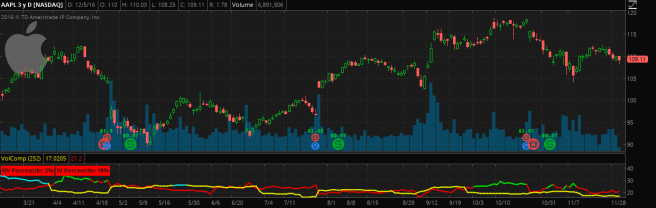
It might be hard to see in the screencap, but when this was taken AAPL’s 45 day realized volatility was sitting in the 2nd percentile and IV in the 13th percentile, with about a 4 point differential between the two. This seems like a good place to buy in some vol for two reasons, the first of which is that IV relative to itself is depressed. The second reason is that realized vol relative to itself is on the extreme low end, which implies we can expect to see a rebound at some point in the future, pushing IV with it.
So how do we go about buying vol? As with selling vol, we have a few ways of going about it. Debit spreads benefit from expanding vol (in that they widen), but come with more delta risk than I want right now. Backspreads have less delta risk but can be tricky to place when we need to keep strike width low. Buying strangles and straddles take on the most vol but are expensive, carry a lot of long gamma, and are short/negative theta. That leaves us with the calendar. Calendars are slow, weird animals that don’t pay much but offer a decent way for us to get long some vega without too much notional or directional risk.
With a calendar or diagonal we’re picking strikes across two different expiries, so it’s important to take a look at the term structure of the underlying before jumping into strike selection. To start, I tossed out the Jan’17 monthlies since I have enough exposure in that month. In keeping with the 30-60 day idea, I looked at the 6Jan17 and 13Jan17 weeklies (32 and 39 days respectively) for the long leg of the calendar. The 13Jan’s at 39 days actually had the lowest average IV of any expiration cycle available so that was a quick choice. For the short leg I went with the 23Dec16’s as the IV was about a full point higher and at 18 days gives us some time for the spread to work.
With a calendar the next step is strike selection. I wanted the most vega exposure I could get since this is a pure vol play so I looked for the best opportunity near the money. It happened to work out that IV in the Jan cycle happened to flatten out right near the ATM 109 strike on both the call and put side. I don’t want to buy already inflated IV in the hope it will inflate further, so I went with the ATM strike for the long leg. In the front week the IV curve is similar so I went with the ATM strike as well, trading the vega I lose from selling ATM with the directional risk I’d be taking on by selling OTM.
The final step is decided whether to sell a put or call calendar. Since ATM IV on both sides was just about the same (~15%) and the both spreads are fairly cheap, I went with both and put on a double calendar for a total debit of $1.05. The risk:reward ratio here is about 1.8:1, but I’ll be looking to take this off in the 25-50% profit range. If the stock moves quickly but IV inflates enough to roll the front week out for enough of a credit to justify the risk of holding the back month, I’ll explore that as well.
I know this was pretty long winded, but calendars are a lot more tricky to deal with than most people realize, including myself the first few times I traded them. They have very strange exposures and move very slowly sometimes. I’m hoping to manage this one in the next week or two.
Apart from that, I also put on an OTM call calendar in FB and sold an IC in BABA with uneven wing widths to sell some skew. Currently we’ve got 7 positions on in 7 of our 10 underlyings (all but BAC, SPY and QQQ).
Today’s Trades (greeks near open):
- BTO AAPL 23DEC16/06JAN17 109 dbl cal @ $1.05
- D: ~0
- G: -4.8
- V: 6.3
- T: 1.9 (note: long vega and theta)
- BTO FB 23DEC16/06JAN17 125 put cal @ $0.27
- D: 4
- G: 0.37
- V: 3.19
- T: 0.42
- STO BABA 13JAN17 80/85/97.5/99.5 IC @ $1.00
- D: 5.8
- G: -2.5
- V: -5.6
- T: 1.7
 Vega Medic