Diversification?

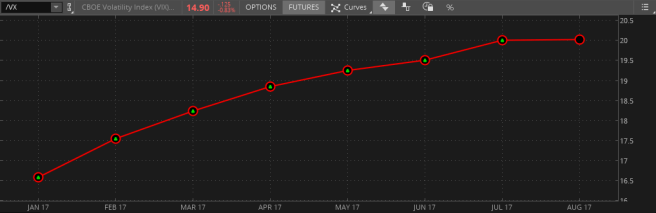
In traditional portfolio management, the investor will spread positions across different asset classes, stock sectors, or market cap to avoid a single event bringing down the entire portfolio. With options trading, we can diversify in similar ways, but we’re exposed to another variable that most stock traders aren’t: volatility. As volatility traders we’re exposed to volatility risk on purpose. We can diversify a volatility portfolio in four main ways: across assets, across time, across strikes, and across strategies. Concentrating trades in one asset class exposes us to macro events in that area and choosing only certain types of strikes and strategies can bring in new types of risk, such as gamma. But what about diversifying across time? To illustrate, let’s take a look at the term structure of volatility futures:
screen-shot-2016-12-02-at-1-11-40-pm

This is a fairly typical vol term structure, where the near term volatility future is trading lower than farther term futures (contango). This intuitively should make sense, as we are more uncertain about the market a year from now as we are a month from now. Sometimes, though, a market-shaking event can occur that causes front month vol to spike and the term structure to enter backwardation. If all of our trades are in one month, that’s where all of our vega risk is, and our entire portfolio is exposed to these types of events.

Where the portfolio currently stands, we’re using around half of our available buying power, all of which is in January options. While we’re fairly diverse in our asset classes (bonds, consumer goods, gold, and small-caps), strikes, and to a lesser extent strategies, I think we’ve got more than enough risk in January. Moving forward, we’ll look to place trades in a different expiration, as well as keep an eye out for long vega trades since all of our current trades are short vega.
PG Vol Play

Day 2 Account Value: $2497.5 (-$2.50/-0.08%)

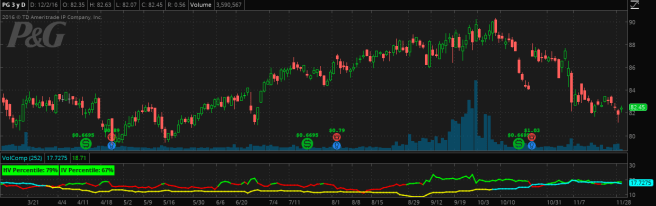
It’s now been a couple days since I put the first two trades on, both of which are marked about the same as where they were placed. Taking a look at our Top 10 this morning, I wasn’t seeing anything interesting until I took a closer look at vol in PG. Realized vol is sitting in the 79th percentile and dropping, while implied vol is in its 68th percentile. More importantly I think is that IV just poked back above HV. With implied now overstating realized vol and thinking that realized vol may begin to trend back towards its long-run average, this looks like a good place for a straight vol selling play. Since ATM options carry the highest vega, I decided to put on an iron fly (capped straddle).

screen-shot-2016-12-02-at-12-16-46-pm

Since an iron fly is by definition selling a straddle and purchasing OTM legs to define risk, that only left the decision of how far OTM to go. Since the Jan’17 strikes are $2.50 wide and I want to keep our maximum risk per trade <10% of our account value for now, I could have gone either $2.50 wide (80/82.5/85) or $5 wide (77.5/82.5/87.5). Going only one strike out would have us buying in a lot of the vol we’re trying to sell with the ATM short strikes (reducing our net vega exposure), so I went with the $5 wide fly.

A little while later I sold a 120/123/136/139 Jan’17 iron condor in IWM to get an index play on. On entry those strikes were around 20 delta on the short side and 12 delta on the long side. Not particularly exciting.

Today’s Trades (greeks near open):

  1. STO 1 Jan17 PG 77.5/82.5/87.5 iron butterfly @ $3.00
    • Delta: -4.2
    • Gamma: -6.96
    • Vega: -9.45
    • Theta: 1.36
  2. STO 1 Jan17 IWM 120/123/136/139 IC @ $1.02
    • Delta: -6.02
    • Gamma: -2.23
    • Vega: -8.52
    • Theta: 1.33

Overall, the portfolio is net short delta/gamma/vega and long theta.