Analgesia

Life is funny. I’ve been rebuilding a convex short position in equities via SPY and QQQ options over the past few months which has just started to pay off thanks to a nearly 300 point rout in the spooz and damn near 1000 in the naz futures. I’m seeing green for the first time in….a long time. I’ve been so deeply entrenched in the mindset of “this is so overextended, this is the top” for the past few years that I’ve left a life’s fortune on the other side of the table.

I was having breakfast with my wife today, sharing with her how I’ve made (back) a few grand over the last couple days. It’s pretty exciting for me, and I’m laying out in general terms how I’ve been betting on the market going down sharply and — surprise! — it has for once. She looks at me at says “haven’t you been making that bet for a couple of years now? Shouldn’t you bet on it going up until it doesn’t?”

My wife is a very smart bird. She knows a ton about what she does for a living, but couldn’t tell a delta dollar from a delta flight. She showed me in a couple seconds that going all-in to position on an asymmetrical return on an unlikely scenario isn’t a good use of our money. Maybe this corona-crash will pay off and I can finally get some satisfaction. Maybe I’ll start trading more objectively and ride trends even if they don’t fit my macro view.

In the meantime, I’m up a grand or so looking to lock in some profits and position myself to be able to trade stock/futures with options. Mostly debit put spreads on SPY/Q’s. My work just did fit tests and handed out N-95’s. I’ll either be dead and rich or a better trader and slightly wealthier. Who knows.

Pain Trades

There’s not too many trading blogs out there that describe in detail just how miserable their performance is. I consider myself a trailblazer in that regard. The short correction in Dec ’18 was a huge boon for me and I was able to roll and adjust my positions in a way that put my risk:reward ratio closer to 1:10, which is crazy. The rip higher in the indices since then has put me close to max loss and at a “pain point” that makes it very difficult to adjust favorably. Most of my spreads are so deep ITM that I can’t roll out to June (from May) to the same strikes without paying and I don’t have enough capital to delta hedge. I’ve continued to put money into the account over the past few months, bringing my cash/sweep to $20,075.80.

Best case scenario, I get a good enough pullback in the indices to roll to June for even or better. Worst case, I close out my positions near May expiry and save up enough money to re open my account with enough to trade delta hedged 1-lots. I don’t really have a vol thesis since the VIX has been trading between 12 and 18 since Feb and while I feel the market writ large is overextended, I’ve been betting on that since 300 points and 3 months ago.

I’ve spent a lot of time in the books the last few months, covering the Schwager’s Market Wizards series, rereading Natenberg and objectively evaluating my strategy.  From Market Wizards I get the impression that the big boyz made their grubstake on a few well placed bets with asymmetrical risk:reward ratios and kept their money trading the traditional way preached in investing books. From Natenberg I’m reminded that a expressing a volatility view without hedging in the underlying is simply expressing a directional view. I’ve been trading like a gambler. I’ll continue looking for ways to wiggle my way into reducing exposure and back into cash. Once I’m 100% cash I’ll need to find a way to trade small enough to trade only the measure I want to, whether that be direction, vol, rates, etc. It’s a blessing to be able to see how wrong you’ve been trading, but an even bigger blessing to have the tools to work out of a bad position into a less bad one. See you in a month or two.

Green Autumn

Last time I wrote (over a year ago!) I had shut down my old positions, topped up my account to $2500 and pretty much stopped trading to get back in the books and re-evaluate my strategies. I’m still in the books a year later but have been trading regularly and have come to a few realizations in the process.

  1. I continue to believe that trading a $2500 account is not a good idea. At that funding level you’re pretty much confined to directional trades, getting lucky, or both. When it comes to selling vol in particular, I was forced to sell very narrow spreads where the wing vega was very near the body vega, ruining the point and turning into a straight (non)-direction and theta play. Hedging delta and gamma at a $2500 funding level is also impossible unless you’re playing very low priced individual names, which has it’s own set of risks.
  2. Trading stock options (vs. index options) is not for me. Between liquidity risk, gap/news risk, and irregular dividends on some names, I’ve decided to stick with equity index options (SPY/QQQ) for now to try and isolate the components I’m trying to trade, which is broad market volatility and direction.
  3. Smaller and wider is better than bigger and more narrow. As my portfolio has started to show some green with the current market rout, I’m finding that spreading as wide as possible to approximate a straddle/strangle flattens my delta/gamma and juices my vega/theta, making my positions more profitable as a result


All this being said, I’m at a point now where I’m comfortable that my position greeks reflect my current market views. I’ve been rolling and widening tranches of short iron condors since May of 2017 (!!!) in SPY and QQQ, slowly adding capital each month to accomplish the positions I want. Twenty points wide in both seems to be the sweet spot for me right now, and my positions range from 12 to 20 wide accordingly. I’ve got 5 and 4 lots each in SPY and QQQ respectively, all in Dec, short a fair amount of delta, flat gamma, short vega, +theta, with a good amount of room for upside movement and lots of room to the downside.

All deposits into the account (net of withdrawals since March 2017) total $8050, which is near the $10k mark I figure is best for option trading as it allows some extra capital for trading stock under the options positions. My cash & sweep is just a hair above $12k and my net liq is wrapped around $2700, which should start coming in as we get past elections and Nov expiry.

Right now the plan is to walk the wings in on my IC’s to release some buying power (targeting $0.10 total for $1 width on both sides) and withdraw any excess above $10k. I just made my first withdrawal in a loooong time of $500, which was a nice feeling. $8050 to go.


Still Fighting

Hello and apologies for the huge post gap, it was a rough first half of the year. To begin, I ended up blowing the $2500 account I started with on the back of the monster post-election rally around March. It didn’t go completely to zero but I had so many trades so deep underwater that I needed to shut things down and take a step back to figure out what went wrong. I ended up topping up the account back to $2500 to start fresh in May, drawing down pretty significantly through the summer, and have just started to claw my way back. This won’t be a full post-mortem on the first account but some big lessons emerged that I think are worth sharing immediately:

Trading vol from the short side on a $2500 account is hard, if not impossible. There just isn’t any room to be wrong, and even if you’re right, there isn’t enough capital to do things like delta hedging, shorting strangles/straddles, etc. When I’m selling vol with a small account, I can only accomplish that on individual names with spreads, and I have to choose between taking on way too much exposure to capture the risk premium (i.e. widening IC’s to resemble strangles), or have a BP-appropriate sized position that isn’t wide enough to actually accomplish the IV position I’m trying to take. At least in this volatility environment, I don’t think it’s smart to try and sell vol anymore with a small account.

Trading vol from the long side on a $2500 account is easier, but can be a slow burning wick. Going back through my trades, I found that buying vol when depressed — via calendars, certain types of verticals, and backspreads — showed more winners than losers, but I tended to close them out a little too early. As low vol tends to beget more low vol, I found that these trades also tend to be more successful when placed further out in time. Calendars in particular can take a very long time to show green.

With a smaller account, I also found that even only trading a dozen or so underlyings was too many. Spreading a small amount of capital across a dozen instruments spread me really thin and gave me even less wiggle room to layer on or manage positions. I’ve since reduced that number to around six.

All in all I’ve learned a great deal about trading these last few months and look forward to posting regularly again, which will probably be in the next month or two. Take care.

Open Book

Happy 2017 everyone! Since the new year began I’ve made about 35 trades, most of which were rolls of our old positions. As the January expiration started getting closer our gamma exposure started to creep up and make itself painfully known. I was seeing huge daily P/L swings (on the order of +/- 10%) and realized I waited way too long to roll our Jan monthlies out to Feb. This was around the 14DTE mark, and hopefully this weekend I’ll get some time to see if that figure is significant or just a coincidence. Regardless, I’ll be looking to roll prior to 14DTE in the future.

As I started making more and more trades this month, it became apparent that documenting them individually is going to get really cumbersome and redundant. Since several of our positions are now turning into multiple spreads layered around one another, I thought it might be best to keep track of things with a public Excel book. Keeping things organized this way will allow us to look back as sort of a trade journal as well as keep track of things like cumulative credit/debit as we roll and adjust spreads over time.

One thing the book has already helped me realize was that, while we’re trading defined risk spreads, we should stay away from BAC. Despite being a very easy instrument to trade options on (liquidity, volume), the low price of the stock means that even though I was able to close our short iron condor for 50% of max profit, I made a net $0 after commissions (2 spreads * 4 legs * $1.50 each way). I wanted to keep some exposure to financials and decided to replace BAC with JPM. Aside from also being a bank, JPM is very liquid with the added benefit of more expensive options by virtue of being a more expensive stock. The 52 week IV range is comparable between the two as well. All in all we made/lost $0, got $200 in margin back and got to watch a short iron condor progress over the course of a month without any adjustments.

Apart from the BAC wash, here’s a quick recap of the other 30 or so trades (which you can see in the excel file):

  1. Closed what remained of the AAPL double calendar for a net loss of $112.50 all said and done. Initial debit was $111 after commissions. Closed the put side then rolled the calls twice for around even. Bad trade start to finish.
  2. Flipped the AAPL backratio into a short Feb 115/120/125 iron butterfly. Initial b/r was $4 wide for $0.16 credit ($3.84 risk), after a series of rolls and adjustments we ended up with a short $5 wide ATM IF for a net credit of $3.62 ($1.38 risk).
  3. Rolled out our BABA IC to Feb. Currently stands as a very narrow ($2.50 wide) short IC with $5 wide wings for a cumulative credit of $2.78. Initial credit was $0.94.
  4. Sold another BABA Feb IC ($7.5 wide, $2.5 wings) for $1.14
  5. Closed the put side of both our GLD short IC’s and rolled out the call sides to Feb, leaving us with 2 GLD Feb 111/114 call spreads for a cumulative credit of $1.19 and $0.87 respectively. Waiting for volatility to perk up a bit before I sell put spreads to reestablish these as IC’s again.
  6. Rolled our IWM short IC up and out. Currently sitting on short 127/130/137/140 Feb for cumulative credit of $1.76, initial was $1.02.
  7. After a series of rolls and adjustments, our PG position is a big nasty triple-decker short iron condor centered around the Feb 82.5 and 85 strikes. This is our biggest play on the board, probably too big. I constructed this as a large short vega trade and with a dividend next week and earnings the week after I’ll be looking to either significantly cut down on size or exit completely as soon as practical. Cumulative credit on the entire position is $8.43 ($7.83 net) with around $2 of risk.
  8. Rolled and adjusted our TLT iron condor into a Feb 115/118/120/123 for a cumulative position credit of $2.14.
  9. Sold an XOM iron butterfly $5 wide for $3.19. Earnings is in 2 weeks.

That’s all for now. I’m starting to get worried about how many February short iron condors and flies I have on as well as possibly getting overleveraged. My account NLV is showing around $2000 while my cash & sweep is over $4500. Due to all the rolling and adjustment I’ve been able to do for credit, I’ve managed to get myself 2x leveraged, and I feel like I’m trading money I don’t have. The goal for this month will be to completely unwind some of our bigger positions (AAPL, BABA, PG, TLT) and see how things look from there. With such a small account I don’t want to risk getting overleveraged and have one bad day completely bomb all of our hard work. I started to lose sight of one of our initial rules:

Don’t become overleveraged…taking on too many positions and becoming overleveraged can result in your account becoming hog-tied…it’s something I want to keep a sharp eye on.

On the bright side, throughout the rolls this week I was able to mind a different one:

No chasing bad trades. If we put on a spread and the underlying goes against us too quickly to defend, we will close the spread instead of rolling and widening the spread to try and chase the win.

Every single one of our rolls was done for a credit (though it did get messy rolling 4 legged spreads in 3 separate orders) and to either the same strikes or farther OTM. Gone are my days of rolling deeper into the money to chase the trade.

trade book (dropbox public file)

2016 Wrap Up

Week 5/Year 1 End NLV (AH): $2402.96 (-97.04/-3.88%)

The obligatory year end postmortem is upon us! Though our net liq (value above) shows us down 3.9 or so percent, it’s nice to see our overall YTD P/L +$43.00. I’m very proud of what we put together so far and excited to see what 2017 will hold. The positive P/L on the year is a nice icing on the cake for us moving forward. As the year is coming to end and our book is fairly well fleshed out at this point, I thought this would be a perfect time to reflect on what we’ve learned so far and map out our plan and goals for the coming year.

Lessons Learned

Two trading months aren’t much to start gleaning deep insight, but I believe we have learned a few things already. First off, and most obviously, was the catastrophic failure of the AAPL double calendar. In retrospect, I have no idea why I put on a calendar so far OTM. It was way too directional to be a straight vega play, and suffered even though IV shot from the 2nd to the 20th percentile in around a week. Had I placed it ATM we probably would have been at max profit today. Lesson learned.

The second lesson is that when placing defined risk trades, if we can’t afford to make the wings sufficiently wide, it might be best not to place the trade at all. On the BAC and PG spreads in particular, the tight wings give us a relatively narrow profit corridor. Apart from simple price dynamics, by buying tight wings we minimize the differential between the vega we’re buying (long strikes) and the vega we’re selling (short strikes). We should strive to come as close as we can to synthesizing strangles and straddles if that’s the type of volatility play we want to make.

The third lesson isn’t really a lesson, but more something I didn’t realize before. If we put on a defined risk trade such as an iron fly or condor, we enter the trade with very specific volatility assumption and risk tolerance. If we roll one side or the other, or adjust the legs, we change the risk profile of the trade. Should we treat this as a completely new trade? Should we take the old trade off and put an entirely new spread on instead? At what point (volatility or price move) should we start making these decisions? I honestly don’t know yet, but I’m going to get in the books soon and try and figure it out. If you have an idea, please leave a comment or drop me a line.

Looking Forward

In the year ahead, I have a single goal: to reach a net liquidating value of $5,000, which is double our starting capital. This milestone isn’t entirely arbitrary; it will open up futures options, the ability to trade naked options on cheaper instruments, and give us some opportunity to buy stock here and there. In addition, I want to stay focused on volatility plays and not stray away from our original rules. We simply don’t have enough capital to try and play big macro trends or stock direction and volatility at the same time in my opinion. For the time being, I’d also like to focus more on ETFs and indices than individual stocks to avoid earnings gap risks. In the upcoming earnings cycle I’m sure we’ll make an earnings play here and there but I forsee it difficult to apply our volatility trading techniques when gap risk is so significant as with earnings. Particularly with defined risk trades, you’re making a bet with unknown odds on either the stock staying within the implied move or blowing it out of the water one way or the other depending on how you play it. I’d rather sell iron condors on a bond ETF with high IV, but we’ll see. Money’s money.

Happy New Year, and Go Blue.

Flying off the Handle

Week 5 NLV (AH): $2308.98 (-$191.02/-7.64%)

Today was the first trading session since the Christmas break and marks the start of the weird period between Christmas and New Year’s where trading gets very thin and big houses start to tidy up their books via position rebalancing, tax selling, etc. Since volumes will start to pick up again in early January leading into the next earnings season starting shortly thereafter, I decided to make some more adjustments today and deploy some dry powder on strategies with nearer than usual expirations. All in all five trades were made today: one roll, one to open, and three adjustments.

Two of those three adjustments were on the SPY and QQQ put debit spreads we opened last week. Price isn’t going where we need it to (down) and IV is ticking up a bit, leading to the spreads showing paper losses of around 10% each as of this morning and needing pretty significant down moves in the coming weeks, which is looking less likely than I originally thought. To take advantage of the recent creep upwards in IV and reduce the capital risk of the spreads, I sold the mirror image of the put spreads originally purchased — turning it into a butterfly, or “flying off” the spread. For the original SPY 223/228 put debit spread, this meant selling the 218/223 put spread for a credit of $0.78 to create a 218/223/228 put fly for a net debit of $1.27. For the QQQ 118/122 put debit spread, it meant selling the 114/118 put spread for a credit of $0.51, creating a 114/118/122 put fly for a net $1.08 debit.

Both of these trades, while not really my favorite way to adjust, raised our upside breakeven points, introduced a bit more short vega/long theta, and reduced our directional exposure (trading it for exposure to large downside moves).

Our other trades today were opening a short iron condor in PG (80/82.5/85/87.5) in the Jan’17 monthlies for $1.07 to offset some upside risk in our current iron fly, rolling down the BABA call half of our IC (again) to the 90/94 for $0.53 to flatten deltas, and selling the 111/114 call spread in GLD Jan monthlies for $0.49.

In the interest of brevity, here’s a snapshot of our current portfolio:

screen-shot-2016-12-27-at-7-27-35-pm

That dumb AAPL double calendar is still killing me and will likely be closed for near even (max loss) tomorrow unless I can pull off a fancy roll that moves it closer to the money without incurring any more margin or cost.

Sleeper Session

Week 4 NLV (Weds close): $2332.88 (-167.12/-6.7%)

More Delta Adjustments

Today’s U.S. session was extremely boring, which was a bummer since I didn’t have anything keeping me away from trading. Slow sessions can be nice since there’s no rush to get things done, but a three point range on the S&P until 3:30PM is like watching paint dry. Volatility across the board is still extremely depressed; in fact, the VIX hit the 10 handle this morning. Regardless, I made a few adjustments I thought I’d share.

If you’ll recall, a few weeks back we sold a GLD iron condor in the January ’17 monthlies for $0.70, with the short strikes near 20 delta. GLD IV — call IV in particular — has gotten smashed since we put the trade on, and the call half of the spread was trading for around a nickel. Being that cheap (and OTM), combined with the low IV, the call legs were contributing almost nothing to our position greeks.  With only a few pennies left to make, all that was left was downside (i.e. capping profits to the upside). I also looked at rolling the spread down but unless I wanted to widen the strikes out and take on more risk, the credit was abysmal. I ended up getting the call spread off for $0.04 + commissions at around 10:00AM, leaving us with a 20 delta, $3 wide put credit spread for a net $0.64 less commissions (so probably $0.50 or so all said and done). Combined with our other GLD spread, our current position greeks are as follows:

GLD Position Greeks: 18.14Δ, -8.39, -11.96ν, 2.00θ

A bit later I took a look at our TLT iron condor to make a delta adjustment, as it was getting a little heavy for my comfort. This spread was initially put on for a credit of $1.27, also with $3 wide wings. Unlike GLD, the TLT IC still had a little juice left in the call spread, so I decided to roll down as a straight delta adjustment, and was able to roll down to the 120/123 for a credit of $0.42, bringing our total credit for the position to $1.69 less commissions. I picked those strikes to bring the spread back close to 0 delta. At the time of the trade, the put legs of the IC had deltas of around 16 and 38, and the call legs we rolled into had deltas of 34 and 14.

TLT Position Greeks: 1.03Δ, -6.43γ, -9.15ν, 1.77θ

Dividend Risk

Overall though, today was pretty good P/L-wise, ending up about $52 on the day thanks to the Russell taking a dive in the last hour of trading. Speaking of which, tomorrow IWM goes ex-dividend, which is important for options traders. Any time you find yourself short calls on a stock or ETF that’s about to go ex-div, you’ve got exercise risk — that is, risk that the buyer of the call you sold will exercise in order to receive shares and therefore the dividend that comes with them. It’s crucial to determine how much risk your short calls have of being exercised — nothing’s worse than waking up and finding yourself short $80,000 worth of SPY on a $2,000 account. I know first hand, and it doesn’t end pretty…I was able to cover the position on open and only ended up eating $800, which sucks but is a lot less than $80,000!

Anyway, the main idea with dividend risk is that if the extrinsic value (time value premium) left in your calls is greater than the value of the dividend, you’re more than likely good to go. This makes sense intuitively if we use an example. Let’s say IWM is trading for $100 and you’re short a $99 call, which is currently trading for $3. Tomorrow’s dividend is $1. The person that bought that call has two options going into ex-div day: sell the call for $3 or exercise to buy 100 shares for $99 (netting $1/share if sold for $100 tomorrow) and receive a $1 dividend. Which would you pick, $3 or $2? The extrinsic value of the call here is $2, since it’s trading for $3 and $1 ITM.

screen-shot-2016-12-21-at-8-10-25-pm

In ToS, you can see how much extrinsic value an option has by adding it in your option chain settings, or simply taking the market value of the option and subtracting the amount by which it is in the money. In the case of our IWM IC, we’re short the $136 call, which closed around $2.71. Since IWM closed at $137, that means the call has (had) $1.69 of extrinsic value. The IWM dividend, from what I can find, will probably be no more than $0.70. Is the call an exercise risk?

Portfolio Greeks (AH, unweighted): -79.12Δ, -38.67γ, -27.62ν, 7.52θ
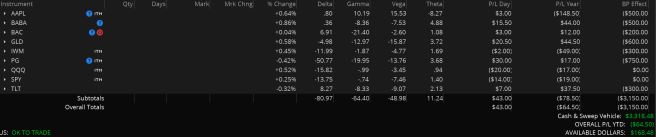
More Delta Adjustments

After opening the two put spreads and adjusting the AAPL double calendar, I had two more delta adjustments to do. Our short IC’s in IWM and BABA (remember we adjusted one of the wings here to limit downside exposure) were coming in decently from a vol perspective but position deltas in both were beginning to get out of control. Early in the afternoon the delta on the BABA IC was more than triple the vega, and 10x for IWM, indicating we had much more directional exposure as volatility exposure. Since both spreads were put on as volatility plays, I want to minimize directional exposure before it begins to completely engulf the position.

For BABA, I rolled the short call leg of the IC from the 97.5 strike to the 94.5 strike for a $0.36 credit, cutting down our position delta from around 12 to closer to 3 and getting us short some more IV (recall that the closer to ATM you get, the higher the volatility exposure). This leaves us with 13Jan16 80/85/94.5/99.5 IC for a total credit of $1.36 less commissions.

BABA Position Greeks: 3.37Δ, -5.88γ, -7.83ν, 3.49θ

IWM was a little more tricky because the underlying has had such a rally — and accompanying IV depression — since we put the spread on initially. I waited perhaps a bit longer to adjust than I should have because of how much time remained on the spread, but with the position delta nearly 30 with vega closer to 3, I felt the need to pull the trigger today. I ended up rolling the put half of the IC up to the 129/132 for $0.45 credit, cutting the position delta by around 66% and adding some more short vega in the process. Remembering that the IC was put on initially for $1.02, our new cost basis is $1.47 less commissions.

IWM Position Greeks: -11.68Δ, -1.51γ, -4.37ν, 1.05θ

Finally, the index ETF put spreads (SPY/QQQ). I don’t normally like to make directional bets, but with the VIX tapping the mid-11’s today and both near all time highs, I wanted to put on trades that would benefit from a move down or an increase in IV. The calendars were trading a little more rich than I cared for and any backspread for a credit would have been way too wide for me to be comfortable with, so I settled on put debit spreads. With debit spreads I like to buy a strike or two in the money so I’m buying more intrinsic than extrinsic (volatility/time premium), and sell at least $2-3 dollars OTM. For a put spread, this gives us the opportunity to not only sell some skew but also be able to adjust the short strike up should price run away from us. Again, not a pure vol play, but definitely gets some help.

  • BTO 1 SPY 27Jan17 223/228 put spread @ $2.00
  • BTO 1 QQQ 27Jan17 118/122 put spread @ $1.59

Porfolio Greeks (AH, unweighted): -78.66Δ, -32.54γ, -24.00ν, 6.28θ

Almost all of the spike in portfolio delta comes from the SPY and QQQ debit spreads, which contribute -30 and -31 delta, respectively.

AAPL Adjustment

Week 4 NLV (Monday close): $2331.52 (-168.48/-6.7%)

One of our busiest days so far with six trades, so let’s jump right in! Two of the six trades were to open — long put spreads in SPY and QQQ to take advantage of extremely low volatility and take a small directional gamble — while the remaining four were mostly delta adjustments of existing positions. Keeping in mind that when we put on volatility trades, we want to try and keep our exposure mainly to volatility instead of direction or other factors. As positions evolve, we want to keep an eye on our greeks and take action when those “other factors” (typically delta) begin to overshadow the one we intended to trade in the first place (vega).

The easiest decisions to make when adjusting greeks is the closing of “units,” which are options we have sold and are now worth close to zero. For example, in the AAPL double calendar we bought, the short leg of the put half of the spread was trading at open for 0.01 x 0.02. Is a short option trading for almost zero helping us take advantage of volatility? I’d argue no, in that the price of that option can go down only one penny to no bid x 0.01 and up as far as volatility allows. I closed that leg near the open for $0.02, leaving us long two legs and short one more 23Dec leg (109 call), which was deep ITM and an exercise risk. That leg was rolled one week out to the 30Dec 109 for a credit of $0.05. Including commissions, the entire adjustment was flat within a dollar, leaving us the following adjusted position:

  • (-1 AAPL 30Dec16 109 call, +1 AAPL 06Jan17 109 straddle) @ 1.05

AAPL IV remains in its 2nd percentile, and I’ll be looking to manage this trade as soon as possible. Best case at this point would be a quick move down towards the short 109 call and/or an increase in IV. With 11 days to go on the short call and 18 on the long legs, time is running out.

AAPL Position Greeks (dbl cal + backspread) : -9.79Δ, 10.39γ, 20.62ν, -5.58θ